

What factors affect the load capacity of an i - beam?
Hey there! As an i - beam supplier, I've seen a lot of folks scratching their heads over what affects the load capacity of an i - beam. Well, let me break it down for you in simple terms.
First off, the material of the i - beam plays a huge role. We've got different types like Stainless Steel I Steel, Aluminum I Beam, and Anodized Aluminum I Beam. Each material has its own unique properties that impact how much weight it can handle.
Stainless steel is known for its high strength and corrosion resistance. It's a popular choice in construction projects where the i - beam will be exposed to harsh environments. The inherent strength of stainless steel allows it to support heavy loads without significant deformation. For example, in a large industrial building where there are heavy machinery and equipment, stainless steel i - beams can be a reliable option. The atomic structure of stainless steel gives it a high yield strength, which means it can withstand a certain amount of stress before it starts to permanently deform.
On the other hand, aluminum i - beams are much lighter than their steel counterparts. They're often used in applications where weight is a concern, like in aerospace or some lightweight construction projects. However, aluminum has a lower strength - to - weight ratio compared to steel. This means that for the same cross - sectional area, an aluminum i - beam may not be able to support as much weight as a steel one. But don't count aluminum out just yet. Its lightness can be an advantage in some situations, and with proper design, it can still handle a decent amount of load.
Anodized aluminum i - beams have an added layer of protection. The anodizing process creates a hard, corrosion - resistant surface on the aluminum. This not only extends the lifespan of the i - beam but can also have a minor impact on its load - bearing capacity. The anodized layer can help prevent surface damage, which could otherwise lead to stress concentrations and reduce the overall strength of the beam.
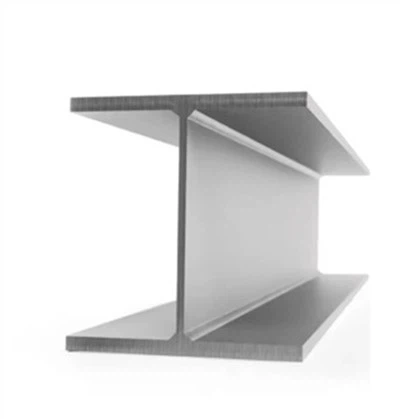
The cross - sectional shape of the i - beam is another crucial factor. The classic i - shape is designed to be very efficient in carrying loads. The flanges at the top and bottom of the i - beam are responsible for resisting bending moments. The wider the flanges, the more effectively they can distribute the load and resist bending. The web, which connects the two flanges, helps to transfer shear forces. A thicker web can handle higher shear loads.
For instance, if you have an i - beam with relatively narrow flanges and a thin web, it may not be able to support as much weight as one with wider flanges and a thicker web. Engineers use complex calculations to determine the optimal cross - sectional dimensions for a given load. They take into account factors like the span of the beam (the distance between its supports), the type of load (whether it's a point load, a uniformly distributed load, or a combination of both), and the allowable deflection (how much the beam can bend under the load).
The length of the i - beam also matters. As the length of the beam increases, its ability to support a load decreases. This is because longer beams are more prone to buckling. Buckling is a phenomenon where the beam suddenly loses its stability and starts to bend sideways or twist under a compressive load. To counteract this, longer i - beams may need to be reinforced or have a larger cross - sectional area.
Let's say you have a short i - beam in a small shed. It can easily support the roof load because it's short and less likely to buckle. But if you try to use the same type of i - beam in a large warehouse with a long span, it may fail due to buckling. Engineers use formulas and design codes to ensure that the i - beam is long enough to cover the required span but also strong enough to resist buckling.
The way the i - beam is supported also affects its load capacity. There are different types of supports, such as fixed supports, pinned supports, and roller supports. A fixed support restricts both translation and rotation of the beam at the support point. This provides more stability and allows the beam to carry a higher load. A pinned support allows rotation but restricts translation, while a roller support allows both rotation and translation in one direction.
For example, in a bridge, the i - beams at the ends are often fixed to the abutments. This fixed support configuration helps the beams to better resist the various loads acting on the bridge, including the weight of the traffic, the wind load, and the seismic forces. If the supports are not properly designed or installed, it can lead to uneven load distribution and reduce the overall load - bearing capacity of the i - beam.


The quality of the manufacturing process is also important. A well - manufactured i - beam will have consistent material properties and a precise cross - sectional shape. Any defects in the manufacturing process, such as cracks, voids, or uneven thickness, can significantly reduce the load capacity of the beam.
During the manufacturing of i - beams, strict quality control measures are in place. For steel i - beams, processes like hot - rolling or cold - forming are used. Hot - rolling can produce i - beams with better mechanical properties because the high temperature allows the steel to be shaped more easily and the grains in the steel to align in a more favorable way. Cold - forming, on the other hand, can be used to create more precise shapes but may introduce some internal stresses in the beam.
Environmental factors can also have an impact on the load capacity of an i - beam. Exposure to high temperatures can reduce the strength of the material. For example, in a fire - prone area, the i - beam may need to be protected with fire - resistant coatings. High humidity and corrosive chemicals can cause the material to corrode over time, which weakens the beam.
In coastal areas where there is a lot of salt in the air, corrosion can be a major problem for i - beams. Regular inspections and maintenance are necessary to ensure that the i - beams are in good condition. If corrosion is detected early, it can be treated to prevent further damage and maintain the load - bearing capacity of the beam.
In conclusion, there are several factors that affect the load capacity of an i - beam. The material, cross - sectional shape, length, support conditions, manufacturing quality, and environmental factors all play important roles. As an i - beam supplier, I understand the importance of providing high - quality products that are suitable for different applications.
If you're in the market for i - beams and need to figure out the best option for your project, don't hesitate to reach out. We can have a detailed discussion about your specific requirements, and I'll do my best to help you choose the right i - beam with the appropriate load - bearing capacity.
References
- "Mechanics of Materials" by Ferdinand P. Beer, E. Russell Johnston Jr., John T. DeWolf, and David F. Mazurek
- "Structural Steel Design" by William T. Segui
- Various industry standards and design codes related to i - beam manufacturing and use.