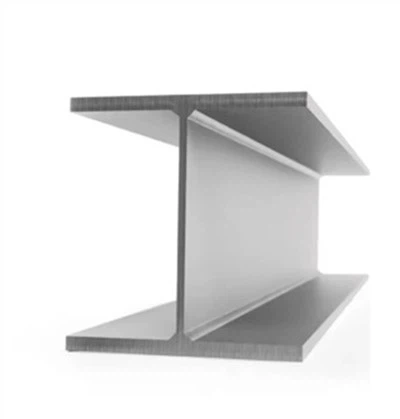


As a supplier of Aluminum H Beams, I've witnessed firsthand the growing demand for these versatile structural components across various industries. One of the critical aspects that often comes up in discussions with customers is the creep behavior of Aluminum H Beams. Understanding creep is essential for ensuring the long - term performance and safety of structures that utilize these beams.
What is Creep?
Creep is a time - dependent deformation that occurs in materials under a constant load at elevated temperatures. Unlike elastic deformation, which is instantaneous and reversible, creep deformation accumulates over time. It is a slow, continuous process that can eventually lead to significant changes in the shape and dimensions of a structure.
The creep process typically consists of three stages: primary creep, secondary creep, and tertiary creep. In the primary creep stage, the deformation rate is relatively high at the beginning but gradually decreases as the material undergoes internal structural changes. During the secondary creep stage, the deformation rate becomes relatively constant. This is often the longest stage and is characterized by a balance between the hardening and softening mechanisms within the material. The tertiary creep stage is marked by an accelerating deformation rate, which can ultimately lead to the failure of the material.
Creep Behavior of Aluminum H Beams
Aluminum H Beams are known for their lightweight, high strength - to - weight ratio, and excellent corrosion resistance. However, their creep behavior is influenced by several factors, including temperature, stress level, alloy composition, and microstructure.
Temperature
Temperature plays a crucial role in the creep behavior of Aluminum H Beams. As the temperature increases, the atomic mobility within the aluminum alloy also increases. This allows the dislocations (defects in the crystal structure) to move more easily, resulting in a higher creep rate. For example, at room temperature, the creep rate of aluminum alloys is relatively low, and the material can withstand long - term loads without significant deformation. But as the temperature approaches the melting point of the alloy (which is around 660°C for pure aluminum), the creep rate can increase exponentially.
Stress Level
The stress level applied to the Aluminum H Beam also affects its creep behavior. Higher stress levels generally lead to higher creep rates. When a beam is subjected to a constant load, the internal stress distribution within the beam is not uniform. The outer fibers of the beam experience higher stress levels compared to the inner fibers. As a result, the outer fibers are more likely to undergo creep deformation. If the stress level exceeds the yield strength of the aluminum alloy, the creep rate can increase significantly, leading to plastic deformation and potential failure of the beam.
Alloy Composition
The alloy composition of the Aluminum H Beam has a significant impact on its creep resistance. Different alloying elements are added to aluminum to improve its mechanical properties, including creep resistance. For example, alloys containing elements such as magnesium, silicon, and copper can form precipitates within the aluminum matrix. These precipitates act as barriers to dislocation movement, thereby increasing the creep resistance of the alloy. Alloys like 6061 - T6, which is a commonly used aluminum alloy for H Beams, have good creep resistance due to the presence of magnesium and silicon.
Microstructure
The microstructure of the Aluminum H Beam, including grain size, texture, and the distribution of precipitates, also affects its creep behavior. A fine - grained microstructure generally provides better creep resistance compared to a coarse - grained microstructure. This is because the grain boundaries in a fine - grained material act as barriers to dislocation movement. Additionally, the orientation of the grains (texture) can influence the creep rate. For example, if the grains are oriented in a way that aligns with the direction of the applied stress, the creep rate may be higher.
Implications for Structural Design
Understanding the creep behavior of Aluminum H Beams is crucial for structural design. Engineers need to consider the long - term effects of creep when designing structures that use these beams. For example, in applications where the beams are subjected to high temperatures or long - term loads, such as in aerospace and automotive industries, appropriate safety factors need to be incorporated into the design.
One approach to mitigating the effects of creep is to use Aluminum H Beams with higher creep resistance alloys. For instance, Anodized Aluminum H Beam can offer enhanced corrosion resistance and potentially better creep performance due to the anodized surface treatment. Another strategy is to limit the stress levels and temperatures to which the beams are exposed. This can be achieved through proper insulation, cooling systems, or by designing the structure to distribute the loads more evenly.
Comparison with Other H Beam Materials
When considering the use of Aluminum H Beams, it's also important to compare their creep behavior with other materials commonly used for H Beams, such as carbon steel and galvanized steel.
Carbon Steel H Steel generally has higher creep resistance at elevated temperatures compared to aluminum. This is because steel has a higher melting point and a more complex crystal structure, which provides better resistance to dislocation movement. However, carbon steel is heavier than aluminum, which can be a disadvantage in applications where weight is a critical factor.
Galvanized Steel H Steel offers good corrosion resistance due to the zinc coating. Similar to carbon steel, galvanized steel has relatively good creep resistance. However, the zinc coating can affect the mechanical properties of the steel, especially at high temperatures. The zinc may melt or react with the steel, which can potentially reduce the creep resistance of the beam.
Monitoring and Testing
To ensure the long - term performance of Aluminum H Beams, it's important to conduct regular monitoring and testing. Non - destructive testing methods, such as ultrasonic testing and eddy - current testing, can be used to detect any internal defects or changes in the microstructure of the beams. Additionally, strain gauges can be installed on the beams to monitor the creep deformation over time.
Laboratory testing is also essential for understanding the creep behavior of Aluminum H Beams. Creep tests are typically conducted by subjecting the beam specimens to a constant load at a specific temperature for an extended period. The deformation of the specimens is measured at regular intervals, and the creep rate is calculated. These test results can be used to validate the design assumptions and to develop appropriate design guidelines.


Conclusion
In conclusion, the creep behavior of Aluminum H Beams is a complex phenomenon that is influenced by several factors, including temperature, stress level, alloy composition, and microstructure. As a supplier of Aluminum H Beams, I understand the importance of providing high - quality products that meet the specific requirements of our customers. By understanding the creep behavior of these beams, we can help our customers make informed decisions when it comes to selecting the right material for their applications.
If you are in the market for Aluminum H Beams or have any questions about their creep behavior and suitability for your project, I encourage you to contact us for a detailed discussion. Our team of experts is ready to assist you in choosing the best solution for your needs.
References
- Dieter, G. E. (1986). Mechanical Metallurgy. McGraw - Hill.
- ASM Handbook, Volume 2: Properties and Selection: Nonferrous Alloys and Special - Purpose Materials. ASM International.
- Aluminum Association. (2003). Aluminum Design Manual.