

What is the moment of inertia of an H - beam?
As an H - beam supplier, I've often encountered questions about the moment of inertia of H - beams. It's a fundamental concept in engineering and construction, and understanding it is crucial for anyone involved in structural design or the use of H - beams.
Understanding the Moment of Inertia
The moment of inertia, also known as the second moment of area, is a property of a cross - sectional shape that describes how its area is distributed around a particular axis. In the context of an H - beam, it plays a vital role in determining the beam's resistance to bending. When a load is applied to an H - beam, it causes the beam to bend. The moment of inertia quantifies how difficult it is for the beam to bend under that load.
Mathematically, for a planar cross - section, the moment of inertia about an axis (x) is defined as (I_x=\int y^{2}dA), where (y) is the perpendicular distance from an infinitesimal area element (dA) to the (x) - axis. Similarly, for the (y) - axis, (I_y=\int x^{2}dA), where (x) is the perpendicular distance from (dA) to the (y) - axis.
Moment of Inertia of an H - Beam
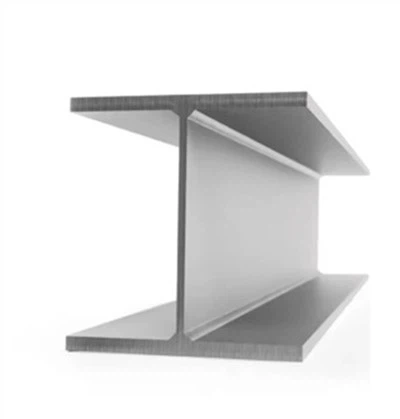
An H - beam has a characteristic cross - sectional shape consisting of two flanges and a web. The flanges are the horizontal parts at the top and bottom, while the web is the vertical part connecting them. The distribution of the area in an H - beam gives it a relatively high moment of inertia, especially about the axis parallel to the web.
Let's consider an idealized H - beam with flange width (b), flange thickness (t_f), web height (h_w), and web thickness (t_w). To calculate the moment of inertia about the (x) - axis (the axis parallel to the web), we can use the parallel - axis theorem. The parallel - axis theorem states that (I = I_{cm}+Ad^{2}), where (I_{cm}) is the moment of inertia about the centroidal axis, (A) is the area of the shape, and (d) is the distance between the centroidal axis and the axis of interest.
First, we calculate the moment of inertia of each component (flanges and web) about their own centroidal axes and then use the parallel - axis theorem to find the moment of inertia about the (x) - axis of the entire H - beam.
The moment of inertia of a rectangular cross - section about its centroidal axis parallel to one of its sides is (I_{cm}=\frac{bh^{3}}{12}), where (b) is the base and (h) is the height of the rectangle.
For the two flanges, the area of each flange is (A_f = b\times t_f). The centroid of each flange is at a distance (d_f=\frac{h_w + t_f}{2}) from the (x) - axis of the H - beam. The moment of inertia of each flange about its own centroidal axis parallel to the (x) - axis is (I_{f - cm}=\frac{b t_f^{3}}{12}). Using the parallel - axis theorem, the moment of inertia of each flange about the (x) - axis of the H - beam is (I_f=I_{f - cm}+A_f d_f^{2}=\frac{b t_f^{3}}{12}+b t_f(\frac{h_w + t_f}{2})^{2}).
The area of the web is (A_w=h_w\times t_w), and its centroidal axis coincides with the (x) - axis of the H - beam. So, the moment of inertia of the web about the (x) - axis is (I_w=\frac{t_w h_w^{3}}{12}).
The moment of inertia of the entire H - beam about the (x) - axis is (I_x = 2I_f+I_w).
About the (y) - axis (the axis perpendicular to the web), the calculation is relatively simpler. The moment of inertia of the flanges and the web about the (y) - axis can be calculated directly using the formula for the moment of inertia of a rectangle. The moment of inertia of the two flanges about the (y) - axis is (I_{f - y}=\frac{t_f b^{3}}{6}), and the moment of inertia of the web about the (y) - axis is (I_{w - y}=\frac{h_w t_w^{3}}{12}). The moment of inertia of the entire H - beam about the (y) - axis is (I_y=I_{f - y}+I_{w - y}).
Importance in Engineering Applications
The high moment of inertia of an H - beam makes it an excellent choice for structural applications where resistance to bending is crucial. In building construction, H - beams are commonly used as beams and columns to support heavy loads. The ability of an H - beam to resist bending allows for longer spans and more efficient use of materials.
For example, in a large - scale industrial building, H - beams can be used as the main structural members to support the roof and floor loads. The high moment of inertia ensures that the beams do not deflect excessively under the weight of the structure and any additional live loads, such as snow or equipment.
In bridge construction, H - beams are also widely used. They can be used as girders to support the deck of the bridge. The moment of inertia of the H - beams helps to distribute the load evenly and prevent excessive bending, which could lead to structural failure.
Different Materials and Their Impact on Moment of Inertia
As an H - beam supplier, we offer H - beams made from different materials, each with its own properties that can affect the overall performance related to the moment of inertia.
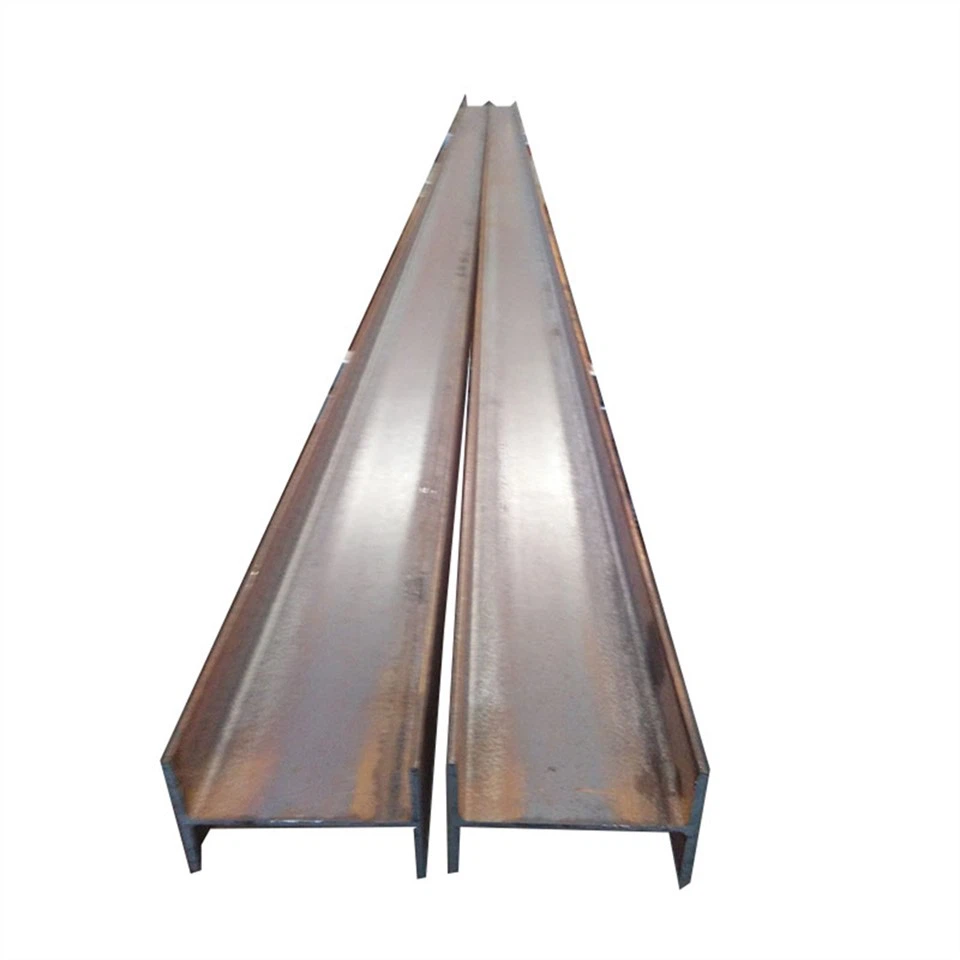
Galvanized Steel H Steel is a popular choice. Galvanization provides a protective layer on the steel, preventing corrosion. The density of steel is relatively high, which means that for a given cross - sectional shape, a steel H - beam will have a certain mass. The material properties of steel, such as its modulus of elasticity, also play a role in how the beam behaves under load. A higher modulus of elasticity means that the beam will deform less for a given load, and the moment of inertia, combined with the material properties, determines the overall stiffness of the beam.
Aluminum H Beam is another option. Aluminum is much lighter than steel, with a lower density. However, it also has a lower modulus of elasticity compared to steel. While the moment of inertia of an aluminum H - beam with the same cross - sectional shape as a steel H - beam is the same from a geometric perspective, the aluminum beam may deflect more under the same load due to its lower modulus of elasticity. Aluminum H - beams are often used in applications where weight is a critical factor, such as in aerospace or some types of transportation structures.
Carbon Steel H Steel is a common and versatile material. Carbon steel has good strength and is relatively cost - effective. The moment of inertia of a carbon steel H - beam, along with its material properties, makes it suitable for a wide range of construction and engineering applications.

Conclusion
In conclusion, the moment of inertia of an H - beam is a key property that determines its resistance to bending. Understanding how to calculate and utilize this property is essential for engineers and designers in various fields. As an H - beam supplier, we are committed to providing high - quality H - beams made from different materials to meet the diverse needs of our customers. Whether you are working on a small - scale construction project or a large - scale infrastructure development, the right H - beam with the appropriate moment of inertia can make a significant difference in the performance and safety of your structure.
If you are interested in purchasing H - beams for your project, we invite you to contact us for further details and to discuss your specific requirements. Our team of experts is ready to assist you in selecting the most suitable H - beam based on your design needs and budget.
References
- Beer, F. P., Johnston, E. R., Mazurek, D. F., Cornwell, P. J., & Self, B. P. (2012). Mechanics of Materials. McGraw - Hill.
- Gere, J. M., & Goodno, B. J. (2012). Mechanics of Materials. Cengage Learning.